Explainer · Hair
Trichoscopy: measuring hair loss years before you see it
Density per square centimeter, shaft caliber, follicular units. The scalp under magnification changes long before the mirror does.
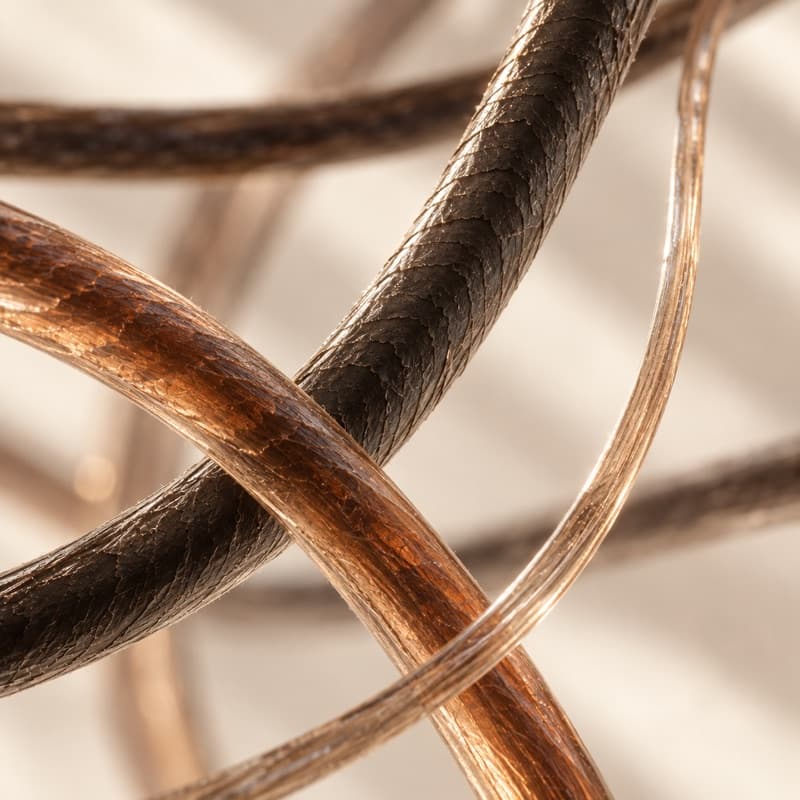
Hair loss is a slow measurement problem. Follicles do not disappear; they miniaturize, producing thinner, shorter hairs over successive cycles, and the scalp compensates visually until the process is far along. Dermatologists estimate that by the time an area reads thin in a mirror, its density has already fallen by around half.
Trichoscopy, scalp imaging under 20 to 70 times magnification, replaces that late visual check with numbers that move years earlier.
A trichoscopic exam counts hairs per square centimeter, measures shaft diameters, and tallies how many hairs emerge from each follicular unit, normally one to four. Healthy density varies widely: a systematic review across 40 studies found means from about 155 to 211 hairs per square centimeter depending on ancestry, with large differences between scalp regions in the same person. The useful comparison is therefore your own frontal scalp against your own occiput, and your own numbers over time.
Pattern hair loss announces itself in caliber before it shows in coverage. As follicles miniaturize, thick and thin shafts mix, and diameter diversity above 20% within one field is the earliest recognized sign. The standardized criteria for female pattern loss build on this: thinner average shafts at the front than the back, more than 10% fine hairs below 0.03 mm frontally, and characteristic follicular dots; two major criteria diagnose with 98% specificity. A normal ratio of growing to resting follicles sits near 85 to 90% anagen, and a shift toward resting shows in counts months before density visibly falls.
Treatment preserves follicles better than it resurrects them. In the pivotal two-year trial of finasteride in 1,553 men, treated scalps held or regrew about 138 more hairs than placebo in a small vertex circle, on a baseline near 876; the drug works on follicles that still exist. The same logic applies to minoxidil and to every newer option: the earlier the miniaturization is caught, the more there is to keep. A trichoscopic baseline is what makes 'is it working' a measurement instead of a mirror argument.
- 01Rakowska A, et al. Dermoscopy in female androgenic alopecia: method standardization and diagnostic criteria. International Journal of Trichology, 2009.
- 02Buontempo MG, et al. Establishing baselines of hair density measurements across ethnicity, scalp region, and technique: a systematic review. Journal of the American Academy of Dermatology, 2023.
- 03de Lacharrière O, et al. Hair diameter diversity: a clinical sign reflecting the follicle miniaturization. Archives of Dermatology, 2001.
- 04Kaufman KD, et al. Finasteride in the treatment of men with androgenetic alopecia. Journal of the American Academy of Dermatology, 1998.
- 05Fabbrocini G, et al. Female pattern hair loss: a clinical, pathophysiologic, and therapeutic review. International Journal of Women's Dermatology, 2018.